
Morning Routine for Women Over 40: 7 Simple Habits to Start the Day Well
Table of Contents
Affiliate Disclosure: This article may contain affiliate links. If you make a purchase through one of these links, we may earn a small commission at no additional cost to you. We only recommend products we believe may be useful to our readers.
A good morning routine doesn’t need to begin at 5 a.m., include an hour-long workout, or require a perfectly organized kitchen.
Especially after 40, a useful routine is less about doing more and more about creating a few habits you can realistically repeat.
A morning routine for women over 40 can be as simple as getting some natural light, drinking something, moving your body, eating a balanced breakfast when you’re hungry, and deciding what deserves your attention that day.
The goal isn’t to create a picture-perfect morning.
It’s to make the beginning of your day work better for your real life.
Here are seven simple habits worth trying.
Why Your Morning Routine Matters After 40
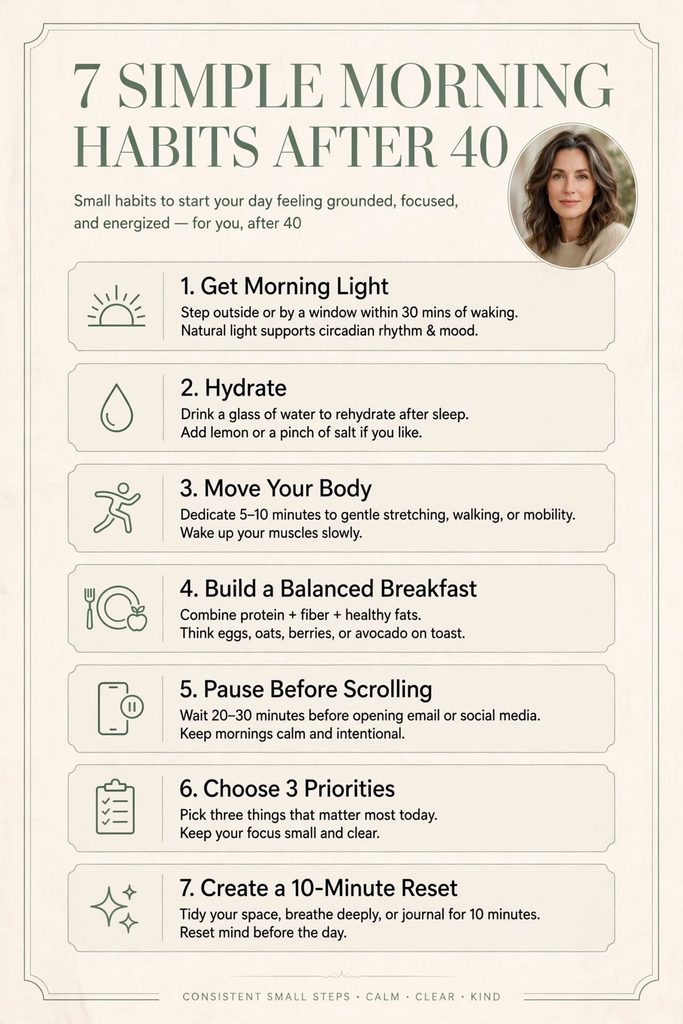
Our routines influence many everyday behaviors: when we get up, what we eat, how much we move, how rushed we feel and how we prepare for the rest of the day.
Midlife can also bring changing schedules and priorities.
Work, family responsibilities, sleep, exercise and personal time can all compete for the same hours.
That’s why complicated wellness routines often fail.
A sustainable routine should reduce decisions rather than create another list of things you feel obligated to accomplish.
Instead of copying someone else’s two-hour ritual, build yours around a handful of habits that fit your schedule.
1. Start With Natural Morning Light
Opening the curtains may be one of the simplest additions to your morning.
Light is an important environmental signal for the body’s circadian system — the internal system involved in regulating our daily sleep-wake rhythm.
Research examining light exposure and sleep suggests that the timing of light matters. A systematic review found that brighter morning light was associated with shifts toward earlier sleep timing and, in some studies, better subjective sleep outcomes. The researchers also noted considerable variation between studies, so this shouldn’t be interpreted as a guarantee that morning sunlight will fix sleep problems.
A simple approach?
Open your curtains after waking.
Have your coffee near a bright window.
Step outside onto the balcony or patio.
Or combine daylight with a short morning walk.
No elaborate “biohacking” routine required.
YourVitaHub tip: Try pairing morning light with something you already do every day. Habit pairing is often easier than adding an entirely new task.
2. Hydrate — Without Turning Water Into a Miracle Drink
You’ve probably seen elaborate morning drinks involving lemon, salt, powders, vinegar or various supplements.
Plain water works just fine.
After several hours without drinking overnight, having water in the morning is simply an easy opportunity to contribute to your daily fluid intake.
Tea, coffee, milk and water-rich foods also contribute fluids throughout the day.
You don’t need to force yourself to drink an enormous bottle immediately after waking.
Keep a reusable bottle or glass somewhere visible and drink according to your needs. See below my top pick water bottle:
Owala FreeSip Stainless Steel Water Bottle 24 oz Iced Breeze
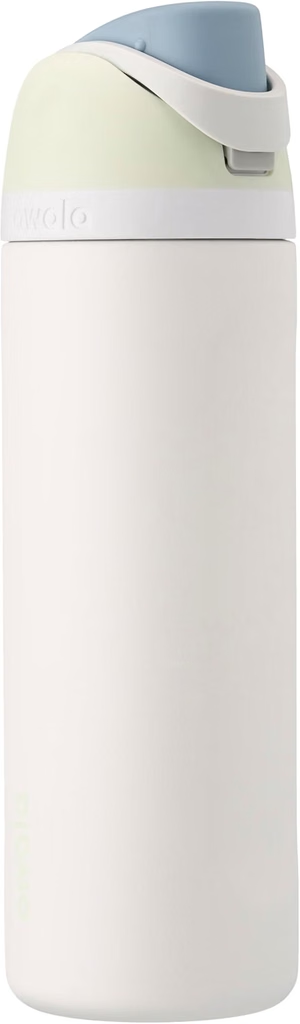
Best seller , view on Amazon
3. Add a Few Minutes of Movement
Your morning movement doesn’t have to qualify as a workout.
It could be:
- a 10-minute walk;
- gentle stretching;
- yoga;
- mobility exercises;
- walking your dog;
- a short strength session;
- simply moving around while getting ready.
And there’s an important distinction here.
Exercise is beneficial, but research doesn’t establish that morning exercise is universally superior to afternoon or evening exercise.
A systematic review involving 35 studies and more than 17,000 participants found inconsistent results when comparing health outcomes according to the time of day physical activity was performed.
So if exercising at 7 a.m. works for you, wonderful.
If your realistic workout time is 5 p.m., you haven’t “missed” the healthy part of the day.
For a sustainable healthy morning routine after 40, movement should fit your life rather than become another source of pressure.
Related: Strength Training After 40: A Beginner’s Guide for Women.
4. Build a More Satisfying Breakfast
Not everyone needs the same breakfast, and not everyone feels hungry immediately after waking.
But if breakfast is part of your routine, think beyond pastries or a cup of coffee on its own.
A balanced breakfast might combine:
Protein + fiber-rich carbohydrate + fruit or vegetables + healthy fats.
For example:
Greek yogurt + berries + nuts.
Eggs + whole-grain toast + fruit.
Oatmeal + yogurt + chia seeds + berries.
Whole-grain toast + avocado + eggs.
Tofu scramble + vegetables + toast.
Protein becomes particularly interesting as we think about maintaining muscle throughout adulthood.
Research on healthy aging has discussed the importance of adequate high-quality protein intake alongside physical activity. Researchers have also noted that breakfast is often one of the lower-protein meals of the day.
More recent observational research involving 48,762 women from the Nurses’ Health Study also found associations between midlife protein intake — particularly plant protein — and higher odds of healthy aging later in life. Because this was observational research, it shows an association rather than proving that a particular breakfast causes healthier aging.
The takeaway is refreshingly simple:
Your breakfast doesn’t need to be trendy.
Make it nourishing and enjoyable.
Read more here:PubMed — Protein and healthy aging
5. Don’t Let Your Phone Decide How Your Day Starts
You wake up.
You check one notification.
Then email.
Then Instagram.
Then the news.
Suddenly, 20 minutes have disappeared.
You don’t need a dramatic “digital detox” to change this.
Try creating a small buffer between waking up and entering the online world.
It might be only 10 or 15 minutes.
During that time you could:
make your bed, shower, prepare breakfast, stretch, sit with your coffee or write down your priorities.
If you use your phone as an alarm, place it somewhere that requires you to physically get out of bed to switch it off. Try this smartsleep:
Philips SmartSleep Wake-up Light, Colored Sunrise and Sunset Simulation, 5 Natural Sounds, FM Radio & Reading Lamp, Tap Snooze, HF3520/60
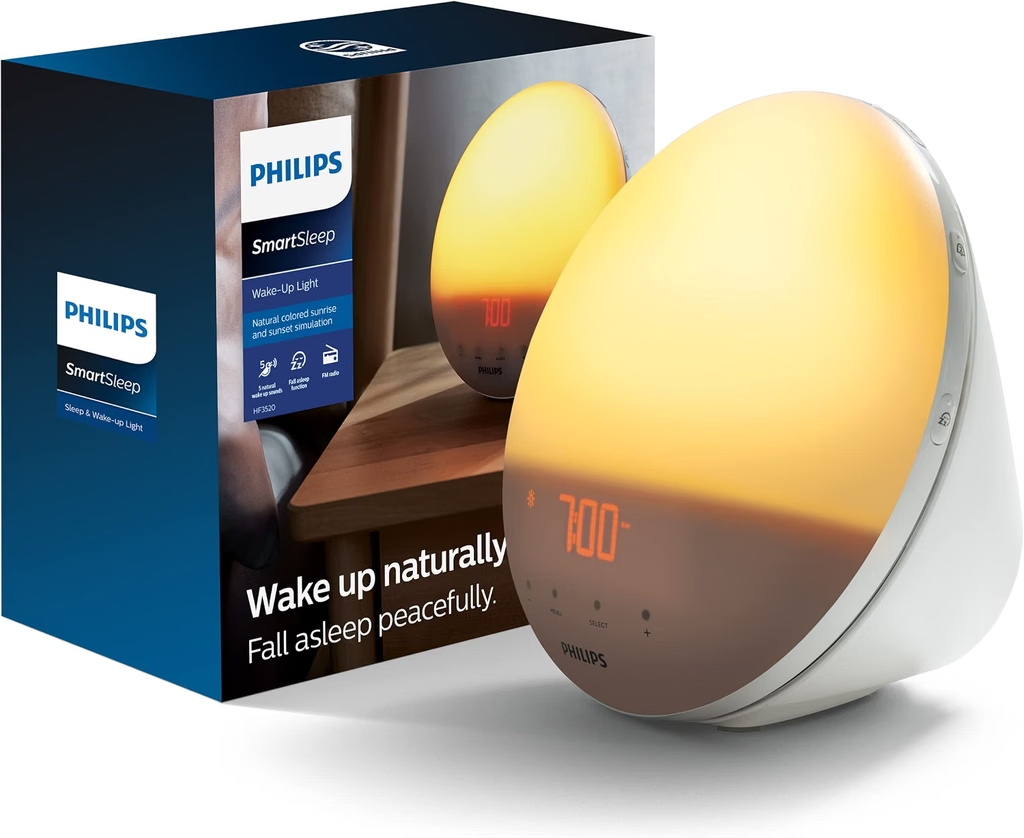
See this best seller on Amazon
6. Choose Your Top Three Priorities
A giant morning to-do list can make you feel behind before the day has even started.
Instead, identify three priorities.
They don’t all have to be work tasks.
For example:
1. Finish an important work project.
2. Take a 20-minute walk.
3. Call someone I’ve been meaning to contact.
Writing them down takes a minute but gives your day some structure.
This is also where journaling can become useful without requiring three pages of writing every morning.
Try answering:
What matters most today?
That’s enough.
Lined Spiral Notebook for Work, 5.7″x7.9″ Spiral Journal College Ruled
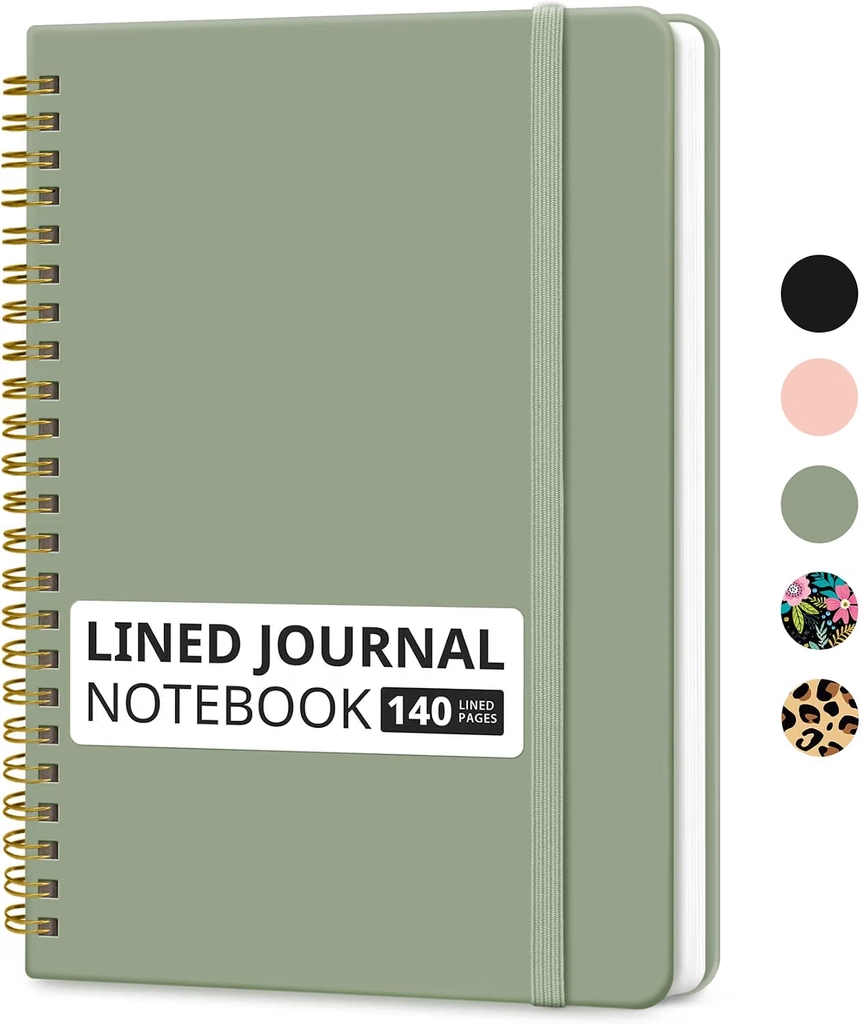
My favorite! See on Amazon
7. Create a 10-Minute Morning Reset
Now combine the ideas into something practical.
Your entire routine doesn’t have to take an hour.
Try this:
Minute 0–2: Open the curtains and get ready for the day.
Minute 2–4: Drink some water and prepare coffee or tea if you enjoy it.
Minute 4–7: Stretch, walk around or do a few mobility movements.
Minute 7–9: Write down your three priorities.
Minute 9–10: Take one quiet minute before opening social media or email.
Then continue with breakfast, showering, commuting, exercising or whatever your actual morning requires.
Ten minutes isn’t magical.
The point is simply to make the routine small enough that you can actually repeat it.
What If You Have More Time?
Great.
Build outward from the basics.
A 30-minute routine might include:
10 minutes of walking.
10 minutes for breakfast.
5 minutes of planning.
5 minutes for skincare or quiet time.
With 60 minutes, you might add a longer workout, reading, journaling or meal preparation.
But don’t assume the longer routine is automatically better.
The best routine is the one that fits your responsibilities and can survive a busy Tuesday morning — not just a peaceful Sunday.
A Simple Morning Routine Checklist
Use this as a starting point rather than a set of rules:
☐ Let natural light into your space
☐ Have some water
☐ Move for a few minutes
☐ Eat a balanced breakfast if you’re hungry
☐ Delay unnecessary scrolling
☐ Choose three priorities
☐ Give yourself a few quiet minutes
Save the checklist somewhere visible until the habits become familiar.
Morning Routine Products You Actually Need — and What You Don’t
A morning routine doesn’t require shopping.
That’s worth saying clearly.
But a few practical items can make habits easier to maintain.
Later, our curated recommendations may include:
Reusable water bottle — convenient if it helps you drink regularly.
Walking shoes — useful if walking is part of your routine.
Daily planner — useful for the three-priority method.
Simple alarm clock — useful if you’re trying to keep your phone away from the bed.
Insulated coffee or tea mug — practical for busy mornings.
Yoga mat — useful for stretching, yoga or home exercise.
Breakfast containers — useful for preparing breakfast ahead of time.
You don’t need all seven.
Choose products only when they solve a real problem in your routine.
How to Make a Morning Routine Stick
Start smaller than you think you need to.
Instead of deciding:
“Tomorrow I’m changing my entire life,”
choose two habits.
For example:
Week 1: Morning light + water.
Week 2: Add five minutes of movement.
Week 3: Add your three daily priorities.
Once something feels automatic, consider adding another habit.
This approach makes your routine easier to maintain when life becomes busy.
Your Morning and Evening Routines Work Together
One of the biggest mistakes in morning-routine content is pretending the morning begins when your alarm rings.
In reality, your morning is strongly influenced by the night before.
Going to bed at a reasonably consistent time, preparing clothes, organizing breakfast ingredients and reducing morning decisions can make the next day easier.
Consistent sleep and wake times are also among the healthy sleep habits recommended by the U.S. National Heart, Lung, and Blood Institute.
That means our morning routine naturally connects to another part of the YourVitaHub wellness system:
Related: How to Create an Evening Routine That Helps You Wind Down.
The Bottom Line
A morning routine for women over 40 doesn’t need to involve supplements, complicated rituals or waking before sunrise.
Start with simple things:
get some daylight, hydrate, move a little, eat nourishing foods, create a small boundary around your phone and decide what matters today.
Then adapt those habits to your own schedule.
A routine should support your life — not become another job.
Frequently Asked Questions
What is a good morning routine for women over 40?
A simple routine might include morning light, hydration, some movement, a balanced breakfast when desired, a few minutes away from digital distractions and planning the day’s main priorities.
How long should a morning routine be?
There is no ideal duration. A useful routine might take 10 minutes or an hour depending on your schedule. Consistency and practicality matter more than creating an elaborate routine.
Should women over 40 exercise every morning?
Physical activity is important, but it doesn’t have to happen in the morning. Research has not established that morning exercise is consistently superior to exercising later in the day. Choose a time you can maintain.
What should I eat for breakfast after 40?
There is no single ideal breakfast. A practical approach is to combine a protein source with fiber-rich foods, fruit or vegetables and healthy fats according to your dietary preferences.
Should I take supplements as part of my morning routine?
Not simply because you’re over 40. Supplements should address an actual nutritional need or individual circumstance rather than being automatically added to a morning routine.
Related guide: Magnesium After 40: Benefits, Types & What Women Should Know.
This article is for educational purposes and is not a substitute for individualized professional advice.
References & Further Reading
PubMed — Protein and healthy aging
PubMed — Dietary protein intake in midlife in relation to healthy aging
PubMed — Light exposure, sleep-wake rhythm and mood: systematic review











Post Comment